Ultimate E-E-A-T Guide SEO: Win Google’s Trust
Strong E‑E‑A‑T is the quiet engine behind modern rankings and brand trust. This EEAT SEO guide explains how experience, expertise, authoritativeness, and trust play together; why Google emphasizes people‑first content; and how to bake these signals into on‑page, technical, and editorial operations that actually help users and survive core updates.
E‑E‑A‑T in a sentence. Prove who created the content, show how it was produced, make clear why it exists, and back it with credentials, structured data, reputable citations, transparent policies, and consistent review. That mix earns trust, which Google treats as the most important E‑E‑A‑T component for sensitive topics and everyday queries alike.
EEAT Guide to SEO: What it is and Why it matters
What E‑E‑A‑T means in Google’s documentation
E‑E‑A‑T stands for experience, expertise, authoritativeness, and trustworthiness. Google uses this concept across guidance to quality raters and public documentation to describe what helpful, reliable, people‑first content looks like. Trust sits at the center. Experience, expertise, and authoritativeness support trust, yet a page that feels untrustworthy falls short no matter how polished it seems.
Google is blunt that E‑E‑A‑T itself is not a single ranking factor. Signals that reflect E‑E‑A‑T are used across systems to prioritize helpful pages and weigh YMYL topics more heavily. That is why strong E‑E‑A‑T pages weather core updates and keep earning citations in AI Overviews and summaries that favor high‑trust sources.
Why E‑E‑A‑T matters for rankings and users
E‑E‑A‑T aligns SEO with how people judge information in the real world. People trust subject matter experts who did the work, cite sources, and stand behind their claims. Google’s Helpful Content approach rewards that same behavior and downgrades thin, search‑first writing that sends readers back to the results page looking for a better answer.
It also protects communities. When health, finance, or safety are in play, low‑trust content is not just a ranking problem. It can mislead people who are making high‑stakes decisions. That is why raters and systems apply extra scrutiny to YMYL topics and why brands in those niches need formal reviews, disclosures, and compliance by default.
E‑E‑A‑T vs Ranking factors and signals
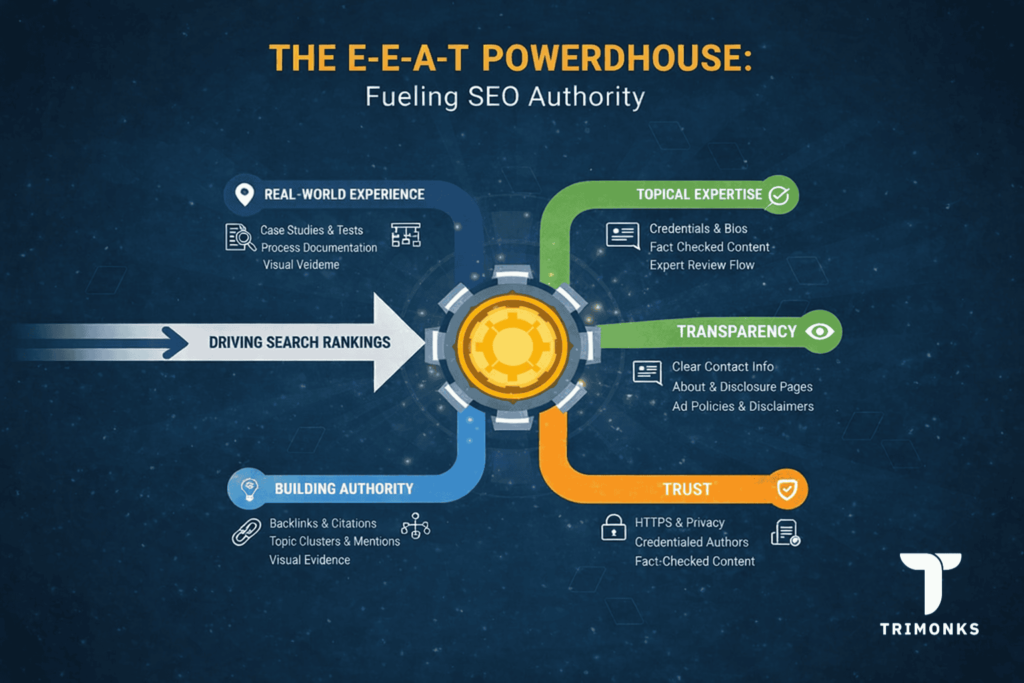
E‑E‑A‑T is a lens. Ranking signals are the measurable pieces that reflect that lens. HTTPS and safe browsing help trust. Structured data clarifies entities and authors. Backlinks from reputable publications reflect authority. Author bylines and bios surface expertise. The framework helps teams decide which signals to invest in, then SEO formalizes them so crawlers can understand and users can verify.
Experience and Expertise Signals for SEO
Demonstrating real‑world experience
Experience means firsthand work, not generic summaries. Practical ways to show it include case studies with process details, test notes and photos, side‑by‑side comparisons with observed outcomes, and review pages that document how tools were evaluated. Google’s guidance repeatedly favors content that shows lived experience over abstract commentary.
- Publish evidence like images from tests, version numbers, and dates.
- Explain constraints and what did not work to avoid a too‑perfect sheen.
- Add how content was produced when readers might ask about methods.
There is a simple saying that fits the spirit here. If you did not do the work, do not publish the claim.
Establishing topical expertise and credentials
Expertise can be formal credentials or deep domain fluency shown through consistent, accurate coverage. For YMYL topics, credentials matter more. For hobby or product content, depth, correctness, and community recognition carry weight. The quality rater guidelines emphasize author reputation and accuracy checks to avoid easy factual errors.
- Use author bios with qualifications and specialties.
- Add expert review flow for sensitive pages with dated reviewer notes.
- Connect author pages with Person structured data and sameAs links to professional profiles and notable publications.
Authoritativeness and Trustworthiness Signals
Building reputation and authoritative coverage
Authority grows when respected sites cite and link your work, when your coverage is comprehensive within a topic cluster, and when your brand is visible beyond your own domain. Search Engine Land notes that high‑trust publications pass authority signals through the links they choose to give, which mirrors how people treat expert recommendations in daily life.
- Publish topic clusters that cover core questions end-to-end.
- Earn mentions through PR, conference talks, and guest features.
- Track link quality and relevance rather than chasing raw volume.
Transparency, safety, and user trust signals
Trust shows up in small things that readers feel while they scroll. Clear contact information. Refund and customer service paths that are easy to find. Safe browsing and HTTPS. Ads and interstitials that do not block main content. Clean language, corrected errors, and honest disclaimers where advice could be misapplied.
Picture a shopper on a late night page, phone glowing on their face. They see a byline, a company address, a simple support link, and citations they recognize. That page feels safe. That feeling maps closely to what the guidelines ask teams to build.
SEO EEAT Guide: On‑page and Technical implementation
Author bylines, bios, and contributor pages
- Add bylines where readers expect them and link to detailed bios.
- Include qualifications, areas covered, editorial policies, and review roles.
- Use internal contributor hubs to list authors and their recent work.
- Surface contact options and social profiles to help readers verify reputation.
Structured data and entity markup
Structured data helps search engines connect people, organizations, and articles. It also helps readers understand who stands behind a page. Start with Organization, Person, and Article types, then add Review and AggregateRating where appropriate. Use sameAs to connect entities to official profiles and authoritative mentions.
| Schema type | Key properties | EEAT benefit | Notes |
| Organization | Name, legalName, foundingDate, address, sameAs | Legitimacy and traceability | Include industry memberships when relevant. |
| Person | Name, jobTitle, affiliation, credentials, sameAs | Visible expertise | Connect to professional networks and publications. |
| Article | headline, author, datePublished, dateModified | Clarity of authorship | Map reviews and edits over time. |
| Review | itemReviewed, reviewBody, reviewRating | Experience evidence | Use photos and test notes alongside markup. |
UX, ads, and technical hygiene
- Keep main content readable and unobstructed by ads or pop‑ups.
- Fix broken links and reduce chains that waste crawl budgets.
- Add alt text and sensible headings that match page summaries.
- Use HTTPS and clear privacy terms to anchor trust signals.
EEAT in SEO Guide: Content operations and Editorial standards
Editorial standards, fact‑checking, and review
Create an editorial standard that normalizes accurate sourcing, expert review, and corrections. For product reviews, disclose test counts and criteria. For advice content, note limitations and risks. Human editors should validate claims, remove vague hedging, and record changes with dates and reviewer names.
Source attribution and external citations
Link to primary research, government pages, and recognized bodies. Use clear anchors that name the source. Reference consensus when multiple reputable sources converge. This habit builds trust with readers and gives crawlers context for your content’s claims.
Content refreshes and lifecycle management
Update pages for factual shifts rather than cosmetic freshness. Remove or consolidate duplicate pages when intent overlaps. Add version notes so readers know what changed and why. Some content is evergreen and still benefits from minor clarifications that keep accuracy high without forcing needless rewrites.
EEAT SEO Guidelines for YMYL niches
Health and finance content requirements
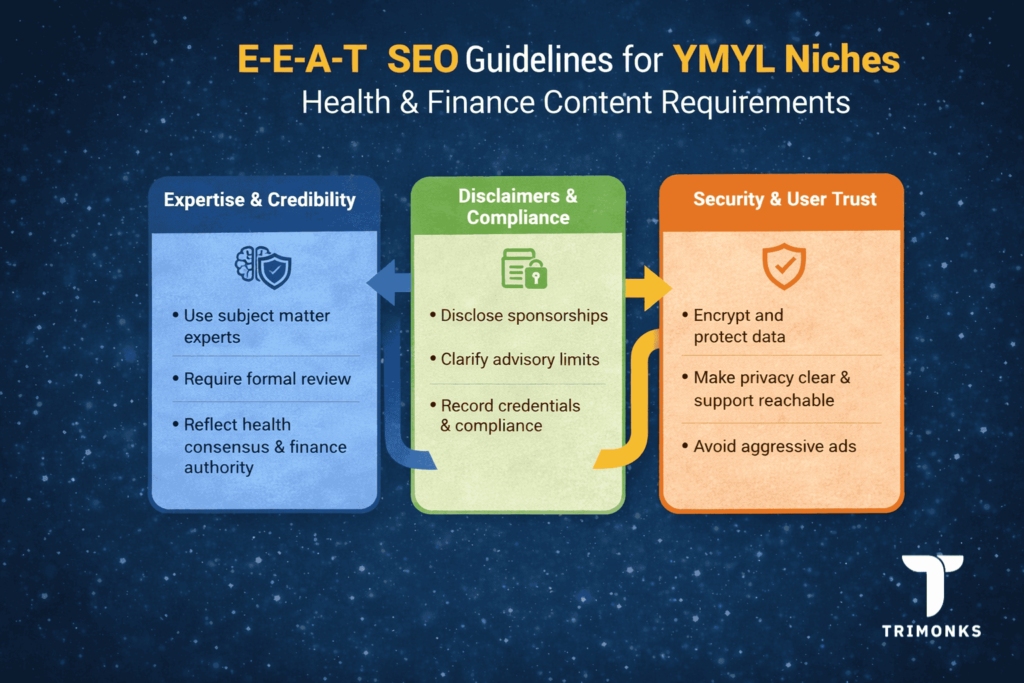
YMYL content needs subject matter experts, formal review, and stronger disclosures. Health pages should reflect current consensus from recognized medical bodies, and finance content should be authored or reviewed by licensed professionals when advice could influence money decisions. Quality raters are instructed to treat inexpert YMYL content as untrustworthy.
Disclaimers, conflicts, and compliance
- Disclose sponsorships and affiliate relationships near recommendations.
- Explain advisory limits. Educational content is not a personal diagnosis.
- Use clear calls to seek professional help for individual cases.
- Record compliance checks and reviewer credentials on the page.
Security, privacy, and ad policies
Encrypt pages, treat user data with restraint, and avoid aggressive ad placement that disrupts reading. Add simple privacy terms and make customer service easy to reach. These are direct trust signals for both users and automated systems that evaluate page experience.
Guide to EEAT for SEO: Measuring and Auditing performance
Metrics, KPIs, and dashboards
E‑E‑A‑T does not compress into a single score, yet it is measurable through a mix of site and brand signals. Track engagement, return visits, helpful internal link flows, author page views, expert review coverage, and structured data validity. Pair that with brand mentions and link quality to see authority grow over time.
| Signal | What to track | Why it helps | Target guidance |
| Authorship | Byline coverage and bio clicks | Proves who wrote content | All advice pages carry bylines. |
| Accuracy | Editor reviews per YMYL page | Reduces errors | Expert review on all YMYL pages. |
| Authority | Reputable referring domains | External validation | Prioritize relevance and trust. |
| Schema health | Validation and sameAs coverage | Clarifies entities | Zero errors on core types. |
Reviews, PR, and third‑party signals
Encourage verified reviews after purchases, seek coverage where expert audiences read, and maintain up‑to‑date social profiles that match site claims. Authority compounds when a brand is recognized across channels, not just inside its own content footprint.
Crawling, indexing, and schema validation
- Run crawl diagnostics and fix broken paths. Better crawling yields more complete cluster coverage.
- Validate schema types and properties. Correct entities connect your people and brand to the wider web.
- Confirm index status for key pages. Missing coverage weakens perceived authority even when content is strong.
Step-by-step SEO Guide for EEAT: A 90‑day Roadmap
Foundation: weeks 1–4
- Inventory authors and add bylines with bios. Map credentials to topics and add the Person schema.
- Publish an editorial standard. Define sourcing rules, review steps, and correction flow for YMYL pages.
- Add Organization and Article schema. Use sameAs to connect official profiles and press mentions.
- Fix page experience snags. Remove intrusive interstitials and repair broken internal links.
Build: weeks 5–8
- Create a cornerstone topic cluster. Cover core questions end-to-end with internal links that guide readers.
- Publish two evidence‑rich case studies. Add test notes, photos, and outcomes to prove experience.
- Launch a review capture loop. Automate post‑purchase emails and display verified reviews with markup.
- Pitch expert quotes and guest features. Earn mentions in reputable publications to grow authority.
Prove: weeks 9–12
- Run a schema validation audit. Clear errors and expand properties where they clarify expertise.
- Update older pages with fresh citations. Add reviewer notes and a visible modified date.
- Build a simple E‑E‑A‑T dashboard. Track byline coverage, review rates, schema health, and link quality.
- Share the results. PR and social posts that highlight research and case work often earn natural links.
Conclusion
Key takeaways
- Trust is the center of E‑E‑A‑T. Everything else supports it.
- Experience is visible work. Show methods, evidence, and outcomes.
- Authority grows through comprehensive coverage and reputable mentions.
- Editorial standards and schema turn good habits into reliable signals.
Manual on EEAT for SEO: checklist and templates
- Authorship template: Byline, bio, credentials, sameAs links, review roles.
- Case study template: Problem, approach, test notes, photos, outcomes, citations.
- Editorial checklist: Sourcing rules, expert reviewer assignment, and correction log.
- Schema checklist: Organization, Person, Article, and Review markup with validation.
- Dashboard starter: Byline coverage, schema errors, YMYL review rate, reputable links.
The most reliable path is slow and visible. Build topic clusters that help real people, show the work, connect entities with markup, and earn mentions beyond your site. Keep this E-E-A-T SEO guide handy, review it quarterly, and let trust be your best signal, just as Trimonks does in its long-term SEO methodology.