How to Use Generative AI for SEO to Increase Your Rankings in AI Results
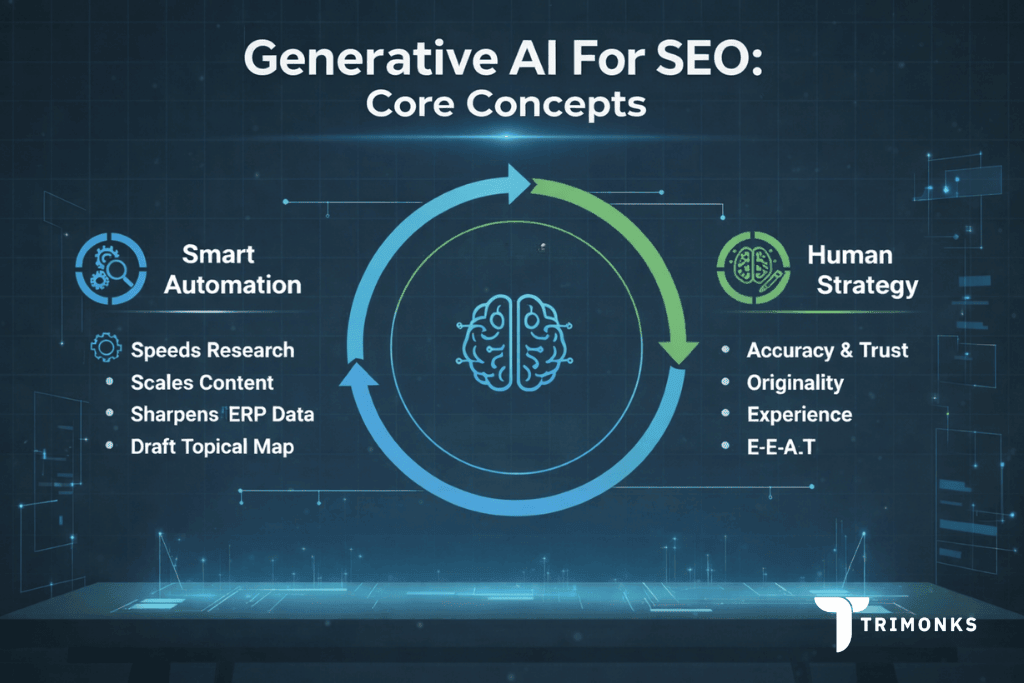
Generative AI for SEO sits where smart automation meets human strategy. It speeds research, scales content, and sharpens on-page decisions while keeping E-E-A-T front and center. Done right, it increases visibility across Google, chat assistants, and emerging AI search, without sacrificing quality or trust.
Generative AI for SEO means using large language models to research, plan, draft, and optimize content, technical elements, and links. Start with intent and topical maps, produce human-edited AI drafts, structure with schema and FAQs, and measure with Search Console, analytics, and experiments. Prioritize unique insights, brand authority, and clean UX for durable gains.
Generative AI for SEO: Definition and Core Concepts
Generative AI in SEO refers to the use of models like ChatGPT and Gemini to accelerate keyword discovery, content creation, on-page optimization, schema work, and technical checks. Think of SEO and Generative AI as complementary: the model helps with patterns and speed, while human judgment delivers accuracy, originality, and experience signals.
Core ideas include topical mapping, entity coverage, conversational intent, and generative engine optimization for AI Overviews and chat-style answers. SEO Generative AI works best when content shows lived experience, cites sources, and is clearly structured with headings, FAQs, and schema. Tools and prompts are helpful, but the differentiator is original analysis and brand authority.
How Generative AI Is Changing SEO in 2026
Search now blends links, snippets, and AI summaries. AI Overviews and chat answers compress informational queries, which often means fewer clicks but steady or rising impressions. Brands with strong rankings, clean structure, and recognizable authority get cited more often. Hidden gem content, unique data, and community signals matter more than generic listicles.
Traffic shifts are uneven. Informational sites and publishers feel the squeeze first, while transactional queries remain resilient. To stay visible, SEO with Generative AI should aim for the top 10, include crisp answers and FAQ sections, and invest in brand mentions and PR. India-focused sites see gains when content addresses local nuance, languages, and trust signals.
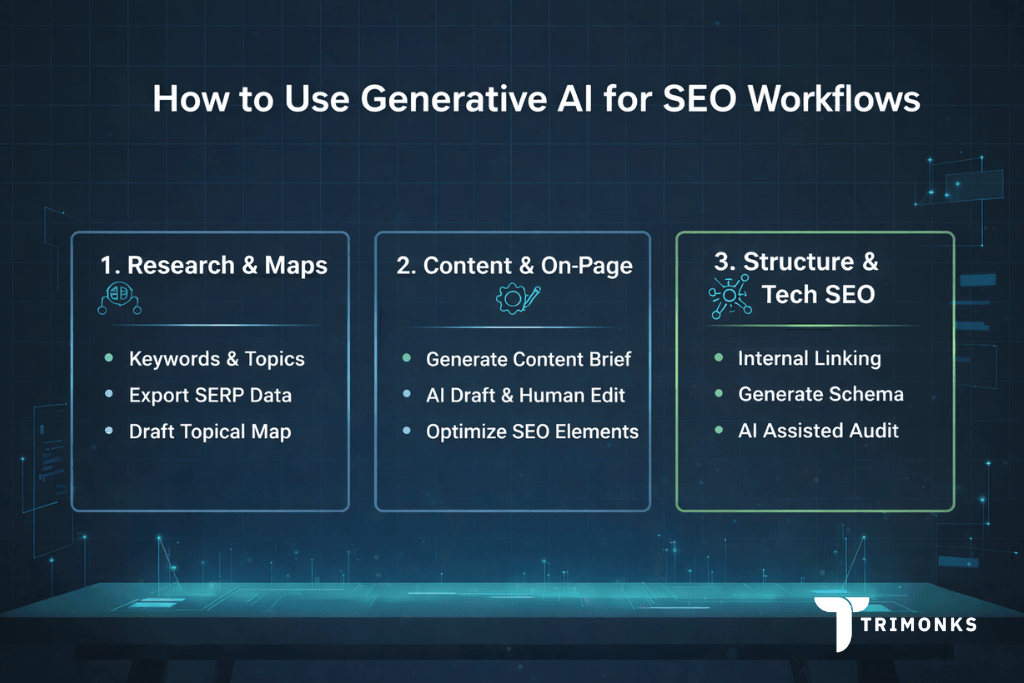
Step-by-Step: How to Use Generative AI for SEO Workflows
Keyword research, clustering, and topical maps
- Ask the model for seed topics tied to business goals. Outcome. A starter list grouped by intent with question variants.
- Export SERP data from Ahrefs or SEMrush and prompt the model to cluster. Outcome. Coherent topic clusters aligned to personas and funnel stages.
- Draft a topical map with pillar pages and supporting articles. Outcome. A roadmap that aligns keywords, entities, and internal links.
Content briefs, AI drafting, and on-page optimization
- Generate a brief with audience, angles, entities, and outline. Outcome. A solid creative direction with E-E-A-T cues.
- Use AI for a first draft, then add human expertise, examples, and citations. Outcome. Unique content that can earn rankings and AI citations.
- Optimize headings, FAQs, meta, and schema. Outcome. Clear structure that surfaces in snippets and AI summaries.
Internal linking, schema, and technical checks
- Prompt the model to suggest internal links by cluster. Outcome. Strong crawl paths and topical authority.
- Generate FAQ, HowTo, and Article schema. Outcome. Better machine understanding and eligibility for rich results.
- Run an AI-assisted audit for broken links, thin pages, and speed. Outcome. Clean technical health and alignment with Core Web Vitals.
Tools: Best Generative AI Tools for SEO in India
General-purpose LLMs and chat assistants
- ChatGPT and Gemini for ideation, briefs, and drafts.
- Claude-style assistants for longer context and careful rewriting.
SEO-specific AI platforms and plugins
- Ahrefs and SEMrush for data with AI clustering and SERP analysis.
- Surfer SEO, BrightEdge, Frase, SEO.AI for on-page guidance and testing.
- AltText.ai and vidIQ for image alt text and YouTube optimization.
| Category | Tool | Best use | India note |
| LLM chat | ChatGPT, Gemini | Briefs, drafts | Multilingual prompts work well |
| SEO data | Ahrefs, SEMrush | Keywords, SERP | Local trends, intent clustering |
| On-page | Surfer, BrightEdge | Entity density | A/B meta testing at scale |
| Media | AltText.ai, vidIQ | Alt text, video | Regional tags and topics |
Prompting Frameworks and Templates for SEO Tasks
Research and SERP analysis prompts
- List intent variants for [topic], clustered by TOFU, MOFU, and BOFU, and add PAA-style questions.
- Summarize the top ranking pages for [keyword], noting content gaps and unique angles.
- Create a topical map with pillars and 10 support posts for [industry in India].
Content optimization and entity expansion prompts
- Expand entities for [keyword] using people, places, tools, metrics, and processes.
- Rewrite this section for clarity, and add a micro-anecdote and a quote that readers might say.
- Generate FAQ questions plus concise answers for snippet readiness.
Link-building, outreach, and digital PR prompts
- Find 20 relevant publications and journalists covering [niche] in India, and draft personalized angles.
- Suggest internal links from our existing posts to this new page; explain anchor rationale.
- Turn our original study into 3 PR hooks and 2 social discussion starters.
Data, Compliance, and Ethical Use in India
Privacy, copyright, and data governance in India
Use only content you own or have permission to use. Avoid sending sensitive data to third-party models. Prefer self-hosted or VPC options for regulated data and document retention policies. This guidance is editor-verified.
Avoiding AI-generated misinformation and plagiarism
Cross-check facts, add citations, and include firsthand examples. AI drafts can blur sources, so run plagiarism checks and cite primary research. Google’s quality updates penalize thin or spammy AI output.
Disclosure, author bylines, and E-E-A-T alignment
Publish clear bylines, credentials, and source lists. Add “how we tested” notes when useful. E-E-A-T matters for rankings and AI citations, so demonstrate experience and trust signals consistently.
Measuring Impact: KPIs and Workflows to Track AI-Driven SEO
Content quality, engagement, and E-E-A-T signals
Track expert citations, dwell time, scroll depth, and return visits. Watch branded searches and PR pickups. Aim for consistent human editorial review of AI-generated content.
Crawl stats, indexing, and Core Web Vitals impacts
Use Search Console to monitor coverage, crawl requests, and indexing patterns. Check speed, layout stability, and responsiveness for every new template. Cleaner code and schema usually help discovery.
ROI measurement, A/B testing, and analytics attribution
Run A/B tests for titles, meta, FAQ blocks, and CTAs. Attribute outcomes to clusters, not just pages, and compare assisted conversions against baselines. Many platforms support automated testing for faster learning.
Use Cases and Examples for Indian Markets
Multilingual SEO for English, Hindi, and regional languages
Generate briefs and drafts in English and translate with post-editing into Hindi, Tamil, Bengali, and Marathi. Include transliterations people actually type and regional examples for authenticity. Voice search queries in Indian languages tend to be longer and more conversational.
Local SEO for Indian SMBs and startups
Create city-specific landing pages with local keywords, directions, and reviews. A Delhi café owner seeing AI summaries push results down the page adds structured FAQs and earns a snippet for “best coffee near Connaught Place.” It’s the small upgrades that show up quickly.
SEO for Generative AI products and programmatic SEO
Publish feature explainers, prompt libraries, and case studies. Use programmatic templates to cover variations at scale, but add unique examples and screenshots. “Don’t ship content you wouldn’t sign” applies here too.
Conclusion and Next Steps
90-day implementation roadmap
- Days 1–30. Build topical maps, cluster keywords, and ship two high-quality pillar pages with FAQs.
- Days 31–60. Add 12 support posts, internal links, and schema, and start PR for brand mentions.
- Days 61–90. Run A/B tests for meta and CTAs, audit speed and indexing, and publish one original study.
Generative AI for SEO is not about replacing strategy; it’s about enhancing it. When AI speed is combined with human expertise, original insights, and strong E-E-A-T signals, SEO becomes more scalable, resilient, and future-ready.
As AI Overviews and chat-based search continue to evolve, brands that focus on clarity, authority, and real user value will stay visible. If you’re looking to apply these practices with an India-first perspective, our AI SEO services in Chennai are designed to blend generative AI workflows with proven SEO fundamentals for long-term growth.