What Is Google AI Mode and How Does It Work?
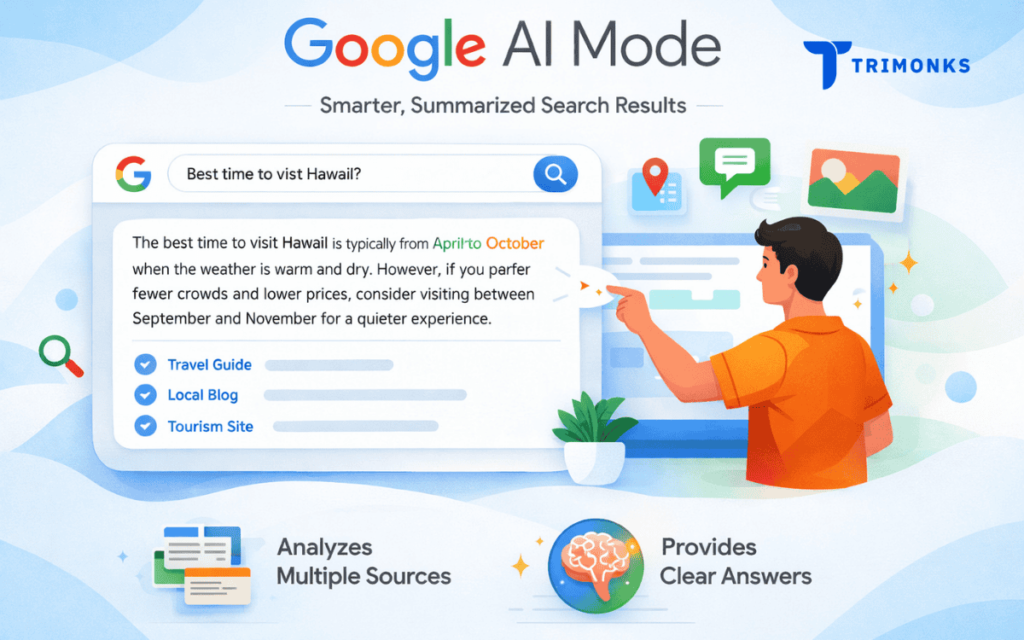
Google AI Mode is Google’s AI-powered search experience that generates summarized, contextual answers directly in search results. Instead of just showing links, it analyzes multiple sources and presents a synthesized response that understands intent and conversation.
In simple terms: it doesn’t just find information — it interprets it.
Google AI Mode vs Traditional Search
| Feature | Traditional Google Search | Google AI Mode |
| Results Format | List of blue links | AI-generated summary and sources |
| Query Handling | Keyword-based matching | Understanding both context and conversational |
| Content Source | Indexed web pages | Multiple source combined answers |
| User Experience | Click and explore | Instant summarized content |
| Optimization Focus | Keywords & backlinks | E-E-A-T + structured clarity |
The Evolution of Google Search
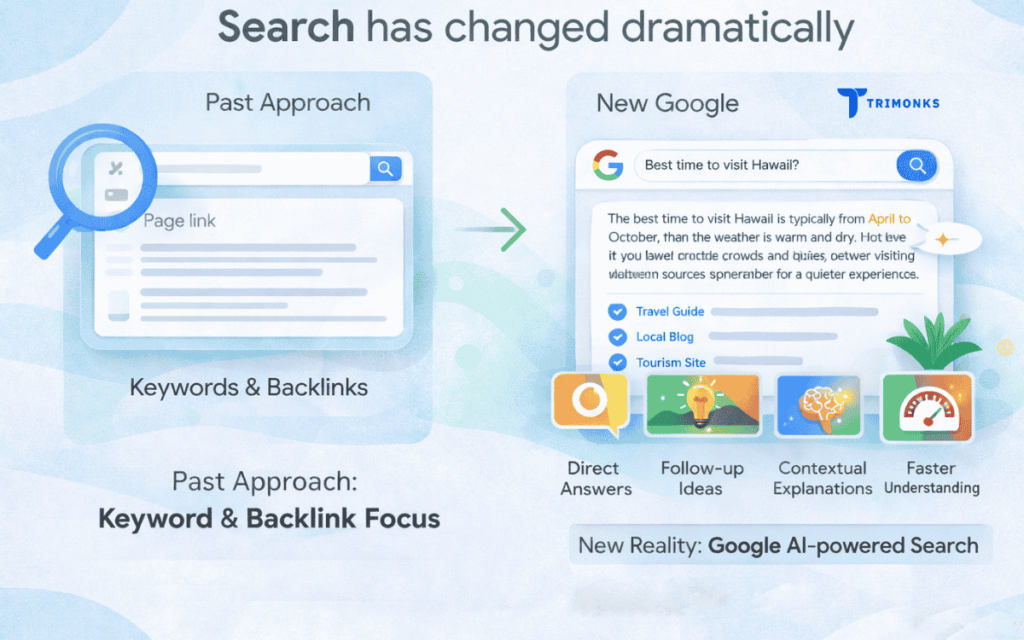
Search has changed more in the last two years than in the previous decade.
Earlier, Google worked primarily on keyword relevance and backlinks. If your page matched the query and had authority, it ranked. Today, user behavior is different.
People expect:
- Direct answers
- Follow-up ideas
- Contextually -aware explanations
- Faster understanding
This is where Google AI-powered search enters the picture. Instead of simply retrieving pages, Google now generates a Search AI overview that explains the topic before users even click a result.
For SEO professionals, digital marketers, content creators and agencies like Trimonks, this shift is not small. It changes how visibility works.
What Is Google AI Mode?
Google AI Mode is built on generative AI models integrated directly into search.
When a user types a query, Google may:
- Identify the purpose of an article
- Collect information from multiple credible sources
- Generate a summarized response
- Provide references
- Allow readers to continue a conversation
This creates a more interactive Google AI search experience.
The key difference?
- Traditional search helps you find answers.
- Google AI Mode tries to deliver them.
How Google AI Mode Works
Let’s break it down practically.
1. It Understands Intent, Not Just Keywords
Google now looks beyond exact-match phrases. It analyzes context, meaning, and relationships between terms.
For example, if someone searches:
“Is Google AI Mode replacing SEO?”
It understands this is informational and strategic — not transactional.
2. It Scans High-Authority Content
The system evaluates:
- Trusted domains
- Structured pages
- Clear explanations
- Websites with topical authority
Thin or vague content struggles here.
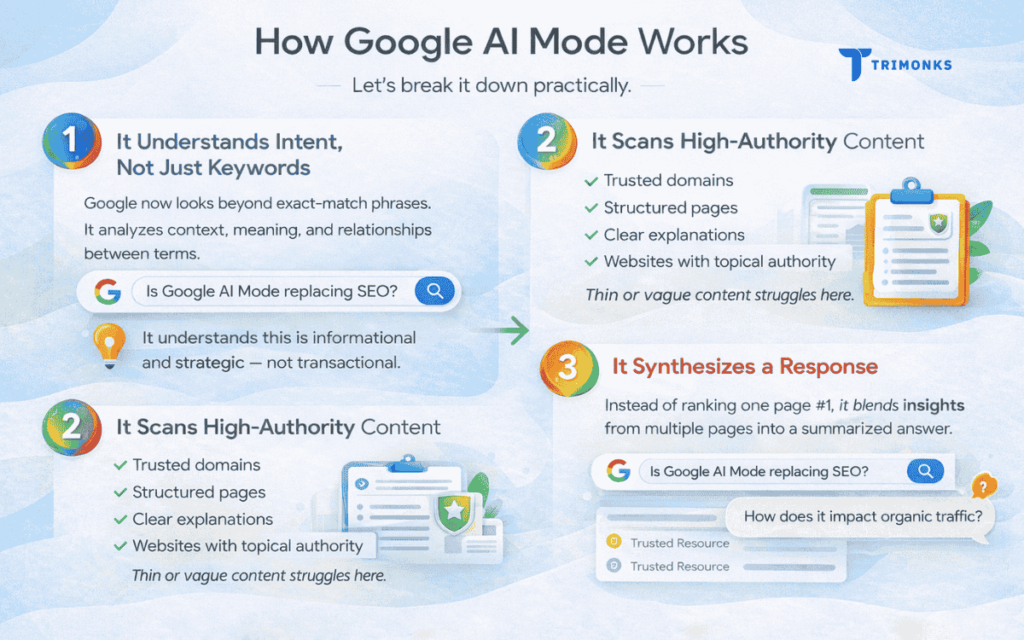
3. It Synthesizes a Response
Instead of ranking First page #1, it blends insights from multiple pages into a summarized answer.
This is why appearing in AI results in Google search requires more than traditional ranking tactics.
4. It Encourages Conversational Search
Users can ask follow-up questions.
This means your content must:
- Cover related subtopics
- Anticipate follow-up queries
- Provide layered information
Surface-level blogs will likely be ignored.
Google AI Mode vs Traditional Search: Why It Matters for SEO
This is where strategy changes.
Traditional SEO focused on:
- Keyword density
- Backlinking
- Meta optimization
- Technical structure
Google AI search ranking factors now lean more toward:
- E-E-A-T (Experience, Expertise, Authority, Trust)
- Clear definitions
- Structured formatting
- Depth of topic
- Semantic relationships
From our experience working on SEO strategies, content that clearly answers questions in the first 100 words tends to perform better in AI summaries.
That’s not accidental. AI prefers clarity.
How to Optimize for Google AI Mode
If you want to appear in Google AI answers, here’s what actually works.
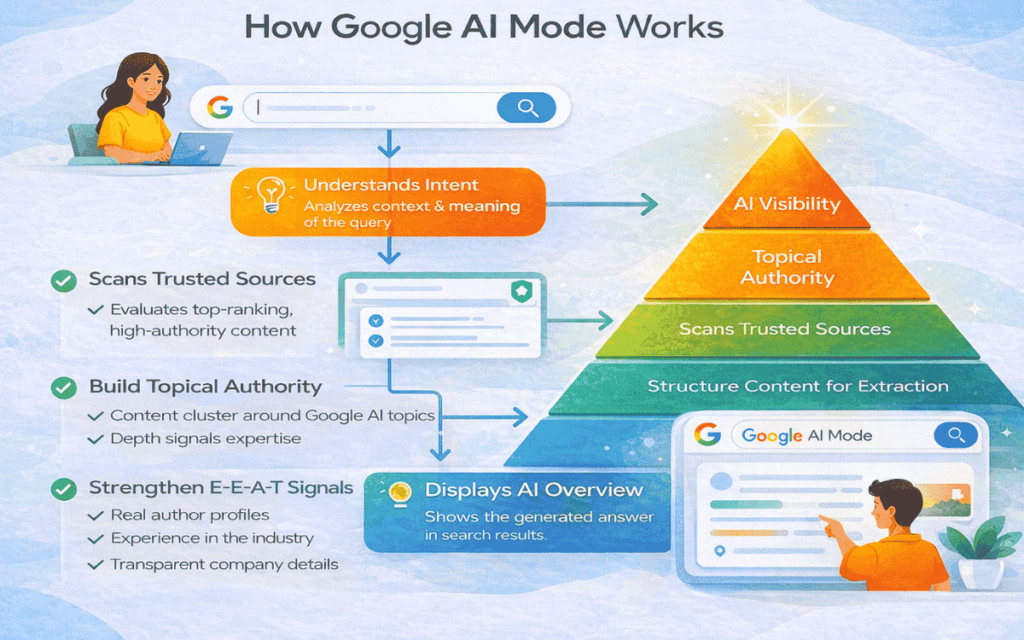
1. Strengthen E-E-A-T Signals
Add:
- Real author profiles
- Experience in the industry
- Transparent company details
Generic content won’t stand out anymore.
2. Structure Content for Extraction
Use:
- Clear H2 and H3 headings
- Paragraphs that begin with definitions
- Bullet points
- FAQ sections
AI systems extract structured content more easily.
3. Build Topical Authority
Instead of writing one blog about Google AI Mode, build a content cluster around:
- Google AI content optimization
- Google AI search ranking factors
- Google AI Mode vs traditional search
- Ranking in Google AI search
Depth signals expertise.
4. Answer Before You Expand
If your blog takes 500 words to reach the point, AI may ignore it.
Lead with:
- Definitions that are clear
- Answers that are direct
- Summaries that are short
Then expand.
5. Improve Technical Clarity
To properly optimize your website for Google AI results:
- Implement FAQ schema
- Use article schema
- create internal linking
- Eliminate the content that has no value.
Technical clarity supports AI interpretation.
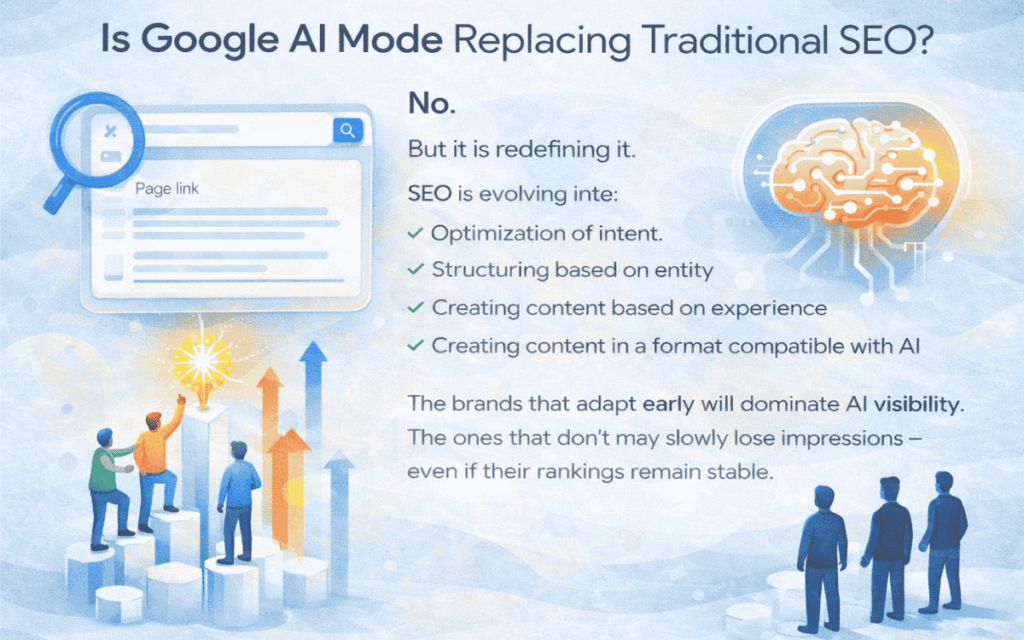
Is Google AI Mode Replacing Traditional SEO?
No.
But it is redefining it.
SEO is evolving into:
- Optimization of intent.
- Structuring based on entity
- Creating content based on experience
- Creating content in a format compatible with AI
The brands that adapt early will dominate AI visibility.
The ones that don’t may slowly lose impressions — even if their rankings remain stable.
What This Means for Businesses
For businesses and agencies like Trimonks, this shift presents a major opportunity.
Websites that:
- Audit AI visibility
- Improve structured formatting
- Strengthen E-E-A-T
Creating comprehensive content will gain an advantage in AI-powered search. Ignoring this change isn’t risky today. But in 12–24 months, it could be.
Conclusion: Prepare for AI-First Search
Google AI Mode is not a trend. It’s the next phase of search evolution.
If you want long-term visibility, you should:
- Audit your website for AI readiness
- Improve structured clarity
- Strengthen expertise signals
- Optimize for conversational intent
- Build topical authority
Search is no longer just about ranking. It’s about becoming the answer.
If you’re serious about adapting your SEO strategy for Google AI Mode, now is the time to act. Agencies like Trimonks are already helping brands future-proof their search visibility with AI-focused SEO strategies.
The earlier you adjust, the stronger your position will be.