How to Optimize Your Website for Claude AI and LLM Search
Search behavior is changing rapidly. Instead of browsing multiple links, users increasingly see AI-generated answers that summarize information from a few trusted sources. When your website appears in those summaries, your brand gains instant visibility and credibility.
AI website optimization is the process of structuring website content so AI systems like Claude AI, Google Gemini, and Perplexity AI can easily understand, summarize, and cite it in AI-generated answers. It focuses on clear summaries, structured data, credible sources, and strong page performance.
Optimizing your website for Claude AI and LLM search means structuring your content so AI systems can easily understand, summarize, and cite it in AI-generated responses. Websites with clear summaries, structured data, strong E-E-A-T signals, and fast page performance are more likely to appear in platforms such as Claude, Gemini, and Perplexity.
We will explore the key strategies businesses can use to optimize their websites for AI-powered search and improve their chances of being cited by modern LLM platforms.
Understanding Claude AI, LLM search, and Why They Matter
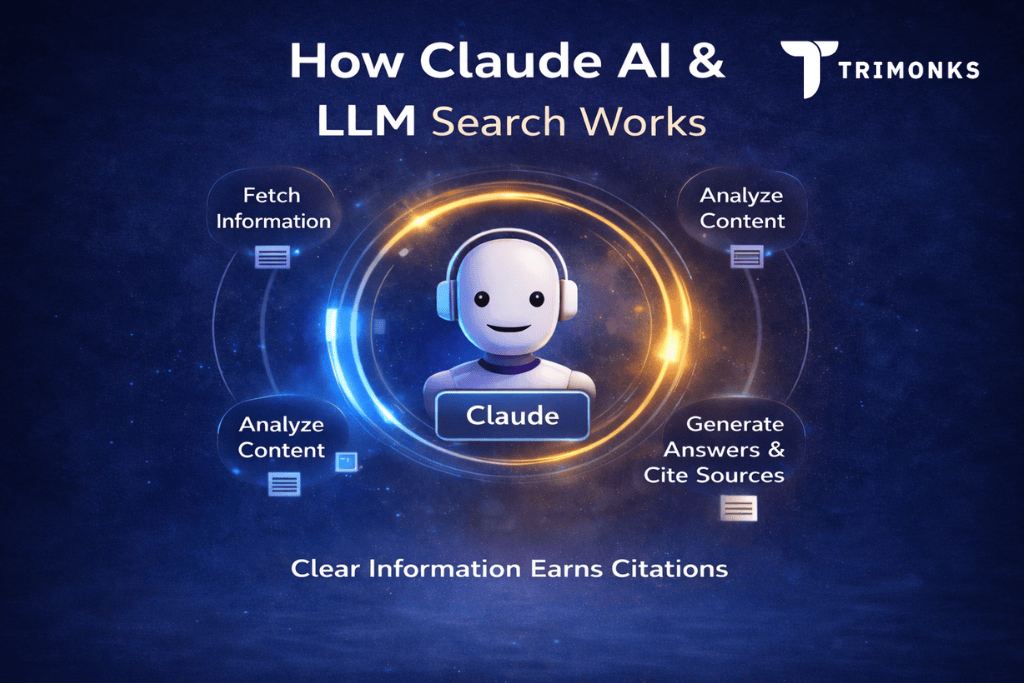
Claude AI is a conversational large language model that reads prompts, reasons over context, and composes answers. LLM search experiences collect information from the open web, then summarize it in natural language, often with supporting links. Google’s AI experiences emphasize helpful, original content and a solid page experience, and this guidance carries into AI formats, according to Google Search Central. AI assistants like Claude AI, Google Gemini, and Perplexity AI prefer sources with clear definitions, structured explanations, and credible references.
Why this matters in India is straightforward. Search here is multilingual. Queries arrive in Hindi, Bengali, Tamil, Marathi, Telugu, Hinglish, and a dozen more tongues. Many people search by voice and expect crisp, direct answers. Connections vary in speed, so pages must load fast on bandwidth-constrained networks. When LLMs fetch and summarize, they tend to quote clear, well-structured pages that match conversational questions. Brands that optimize for natural language and lightweight delivery see better inclusion and more qualified clicks. Businesses in India are already seeing this shift. Pages with structured FAQs and clear answers are increasingly being cited in AI-generated summaries, leading to more qualified traffic.
What is AI optimization? Key Concepts and Ranking Signals
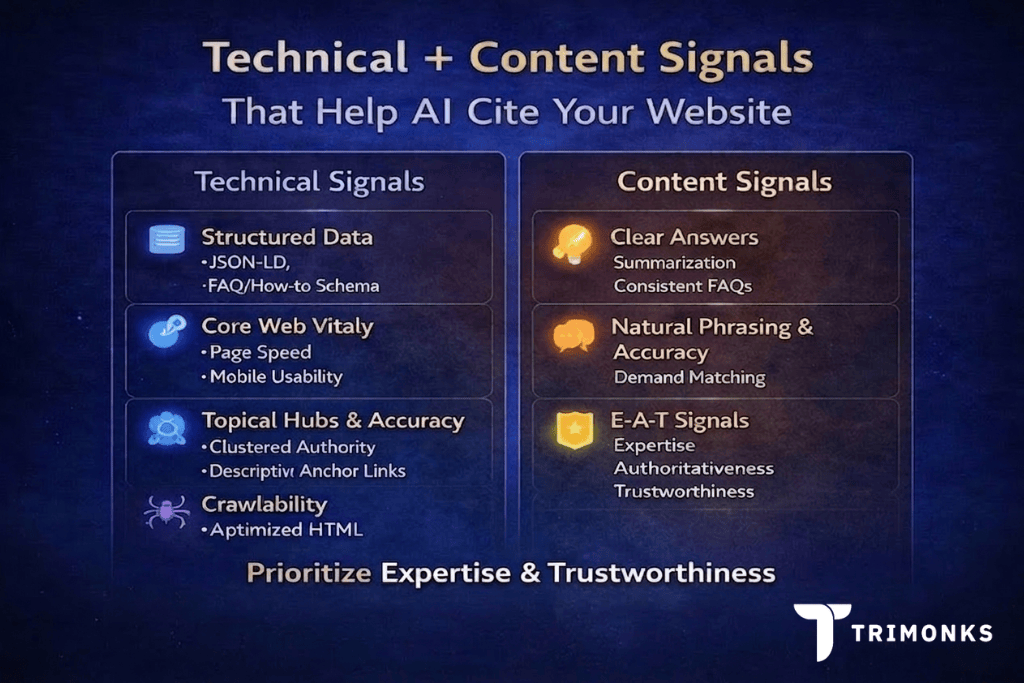
AI optimization, often called answer engine optimization, focuses on making content easy for models to parse, summarize, and cite. The center of gravity shifts from keyword matching to intent clarity, structure, and credibility. Google’s guidance emphasizes helpful, reliable, people-first content; strong page experience; accessible crawling; and structured data that matches on-page content.
| Signal | LLM Search Weight | Why It helps |
| Clear summaries and FAQs | High | Models extract direct answers quickly |
| Structured data | High | Makes entities and formats machine readable |
| E-E-A-T signals | High | Builds trust for citations and YMYL topics |
| Core Web Vitals | Medium | Improves user value and discovery signals |
How Claude AI Evaluates and Ranks Web Content
Claude AI does not rank pages like a classic index. It composes answers and optionally cites sources that best fit the prompt’s intent. Pages with concise definitions, step-by-step instructions, and high-quality references fare better because they are readily quotable. Across LLM platforms, analyses show that clear lists, question-based headings, and up-to-date information are frequently referenced. A study of hundreds of queries found that tools like Perplexity consistently cite sources and favor lists and how-to articles for general topics, while YMYL topics lean harder on high-authority domains and dated titles. This pattern is instructive for crafting content that Claude can confidently reference.
Practical translation. Claude AI is more likely to surface pages that answer the question in the first few lines, expand with structured detail, and point to credible sources. It helps to think like a helpful editor. Give the straight answer first, then add context and nuance. Keep headings literal. Use FAQ sections for likely follow-ups. Provide author details and update dates for trust. These behaviors align with Google’s public guidance and with enterprise recommendations for AI formats. For example, when a user asks how to optimize a website for AI search, AI assistants often cite pages that provide a short definition followed by structured steps and supporting explanations.
How to Optimize Your Website for AI search: A Step-by-Step Roadmap
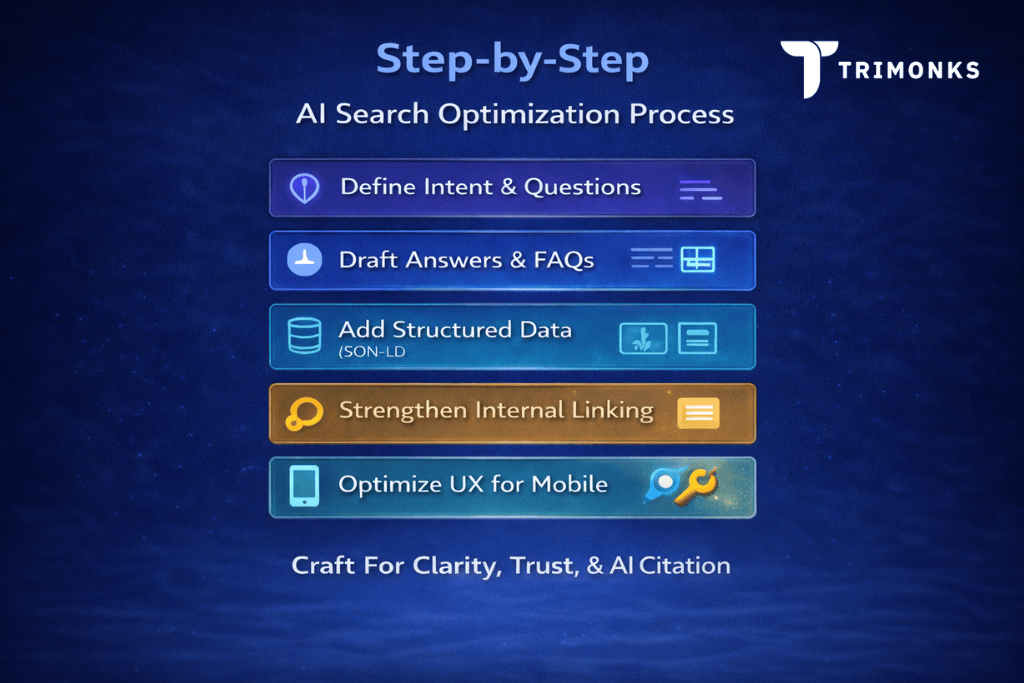
Start with a repeatable workflow that turns every new page into a strong candidate for LLM citations.
- Define search intent and questions to answer, then outline a summary, key steps, and FAQs.
- Write skimmable sections with plain language, lists, and direct answers upfront.
- Add structured data that mirrors visible content, then validate and spot-check.
- Strengthen internal links and topical hubs so context is obvious to crawlers and models.
- Tune Core Web Vitals and compress assets for mobile and low bandwidth in India.
- Publish and test how different LLMs summarize your page, then refine based on gaps.
Site Architecture, Internal linking, and Topical depth
- Create hub pages that list and summarize all subtopics in a cluster. Link out with descriptive anchors.
- Avoid orphan pages. Every article should link back to its hub and two or three sibling posts.
- Use question-based H2s that match conversational queries, such as how to optimize website content for AI search.
- Provide short checklists, process lists, and glossaries. Models quote these directly when relevant.
Structured Data, Entities, and Knowledge Graphs
- Mark up FAQs, HowTos, Products, and Reviews with JSON LD. Validate and keep it in sync with visible text.
- Use Organization markup with sameAs links to authoritative profiles to strengthen your brand node.
- Reference named entities consistently. Write out company, product, person, and location names the same way across pages.
- Do not add markup for content that users cannot see. AI and search guidelines flag mismatches.
Page Experience, Performance, and Core Web Vitals
- Target fast Largest Contentful Paint, responsive interactions, and stable layouts. Good UX helps both users and AI experiences.
- Use modern image formats, lazy loading, and preconnect for critical origins. Serve from a CDN with nodes in India.
- Minimize JavaScript on content pages. Reduce third-party tags that block rendering on budget devices.
How to Optimize Website Content for AI Search
Intent-focused Briefs, Summaries, and FAQs
Start each page with a 40 to 60 word direct answer. Follow with a compact overview and a numbered process if the query implies steps. Close sections with key takeaways. Add a short FAQ that tackles natural follow-ups. Conductor recommends FAQ, HowTo, and skimmable formatting because these structures lift visibility in AI generated answers.
Natural Language, Citations, and E-E-A-T Signals
Use conversational phrasing that mirrors how people ask. Quote trustworthy sources when facts matter and link to them with descriptive anchors. Publish author bios with credentials, include publish and update dates, and keep contact and policy pages obvious. These are strong trust signals for both people and models. Google and platform guides emphasize helpful content and a good page experience, while Squarespace highlights experience, expertise, authority, and trust as key qualities.
Multimodal Assets and Metadata for LLM Understanding
LLMs increasingly mix text with images and video. Unique diagrams, charts, and short explainers with transcripts increase the odds of being cited. Always add descriptive alt text and captions so machines can interpret the visuals.
AI Website Optimization for India: Localization, Languages, and UX
Hinglish and Regional Language Strategy
People often ask in Hinglish, then refine in Hindi or English. Add short bilingual summaries where it makes sense, and include natural phrasing like “sasta best AC for relatable discovery.” Build language-specific pages for Hindi or other high-demand languages with proper internal links and consistent entities. Keep the tone clear and neutral.
Mobile-first, Low-bandwidth Design Patterns
- Optimize above-the-fold content to load within a heartbeat on mid-tier phones. Use lightweight hero images and compressed fonts.
- Use readable font sizes and clear contrast. Keep paragraphs short for small screens. Test on 3G and 4G profiles.
- Cache what you can and avoid autoplaying media. A quiet, fast page feels respectful on patchy connections.
Optimizing Website for AI Search Across Regional Markets
Strengthen local signals that LLMs pick up. Claim and update Google Business Profile. List accurate NAP data across reputable directories. Encourage reviews on trusted platforms. Publish region-specific pages that actually help, such as service areas with unique FAQs and guides. Brand credibility and mentions across communities like YouTube and LinkedIn also help optimize web presence for AI search.
Website Optimization for AI Search and Traditional SEO
Aligning SEO Fundamentals with LLM Discovery
The fundamentals carry through. Crawlability, indexability, and clean metadata still matter. Google’s AI experiences honor the same principles and add preview controls such as no snippet and max snippet to manage how content appears in AI formats. If you wish to participate, do not block known AI crawlers on your site. Keep page content sharp, and then link out to deeper resources. Businesses that want to implement these strategies effectively often rely on structured SEO services to improve technical optimization, content structure, and AI search visibility.
Programmatic Pages, Hubs, and Schema at Scale
Use repeatable templates for hubs and FAQs, then fill them with genuinely helpful content. Programmatic city or category pages only work when each page adds unique, local value. Generate schema along with content, validate regularly, and monitor for drift. Thin, near duplicates do not earn citations and rarely sustain organic visibility.
Tracking AI Search Visibility and Brand Mentions
- Test how different models summarize your key pages. Ask Perplexity, Claude, or Gemini to explain your page and note what is quoted.
- Watch referral traffic from AI sources in analytics. Use regex filters for chat domains and known LLM referrers.
- On supported platforms, use AI visibility tools to track mentions and positions for branded and non-branded prompts.
Conclusion
Answer engines reward clarity, authority, and structure. To show up for Claude AI and LLM search, summarize first; format for extraction; mark up what matters; and demonstrate real experience. For India, prioritize mobile speed and multilingual clarity. Then build a wider web presence so models can validate who you are. As AI-powered search continues evolving, businesses that optimize their websites for AI-driven discovery will gain a strong competitive advantage. If you’re planning to improve your website’s AI search visibility, the team at Trimonks can help you build an SEO strategy designed for both traditional search engines and AI-powered search platforms.