Voice Search Optimization: How to Prepare Your SEO for AI-Driven Search
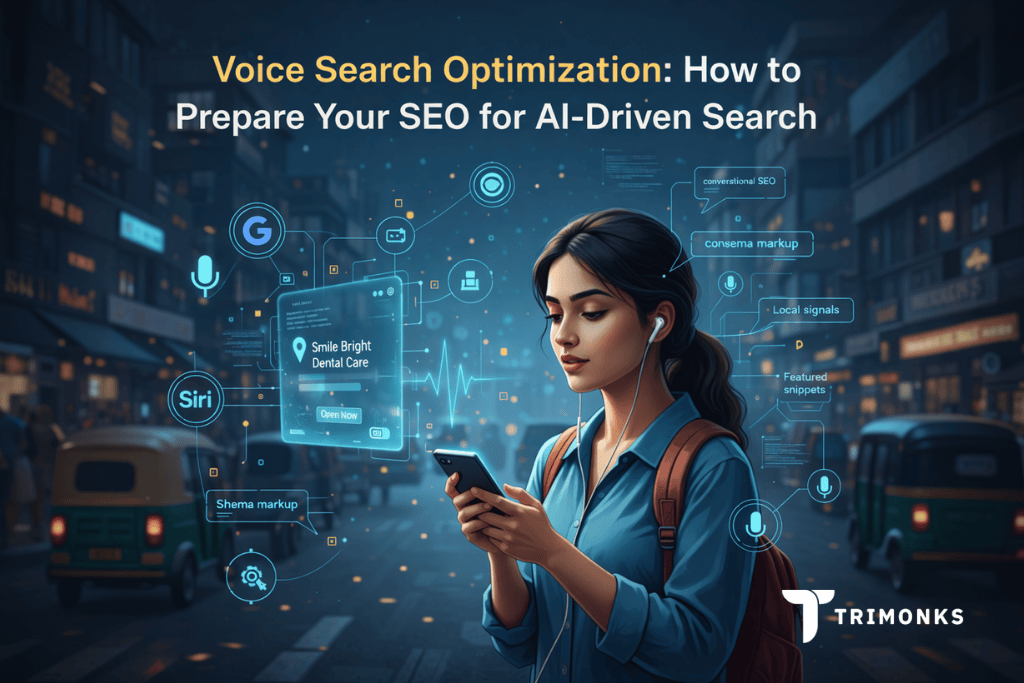
Picture this. A commuter in Pune asks her phone, “Which dentist near me is open now?” The answer she hears is not a list. It is one result. Conversational SEO decides whether that answer is your brand or your competitor’s. Getting voice search-optimized content in front of AI assistants is now part of baseline SEO in India, not a nice-to-have.
Voice search optimization (VSO) is the process of structuring content, schema markup, and local signals so AI assistants like Google Assistant, Siri, and Alexa can select your page as the single spoken answer to conversational queries. It focuses on conversational keywords, featured snippets, schema markup, swift mobile pages, and strong local SEO signals. The goal is to be selected as a spoken result across Google Assistant, Siri, and Alexa.
Why Voice Search Optimization Matters in AI-driven Search
AI assistants collapse the classic ten blue links into a single, confident summary. Ranking fourth still brings traffic in text results. In voice, there is no silver medal. Most voice answers come from featured snippets or other SERP features, so optimizing for voice is really about winning those answer surfaces at scale.
There is also a behavior shift. People ask natural questions when they speak. They add context like “near me,” “open now,” or “for kids.” This intent density makes voice a strong fit for local discovery, hands‑busy tasks, and quick product comparisons. Brands that adapt language and structure to how people talk show up when decisions happen, not after the fact.
For India, the impact is amplified by multilingual usage and mobile-first habits. According to Google and PwC reports, over 50% of smartphone users use voice search weekly. This makes voice optimization especially critical for service-based and location-driven businesses. Optimization for voice search helps people get useful answers the first time, which is the real test of trust.
How Voice Search Optimization Works
How Assistants Parse Natural Language and Intent
Assistants convert speech to text, identify entities and intent, and then look for concise, authoritative answers. Queries tend to be longer and question-led. Think, “How does voice search optimization work for restaurants near me?” rather than “restaurants near me.” Content that mirrors this phrasing and answers in 40 to 50 words aligns with how assistants select a response.
SERP Features that Power Voice Answers
Google, Siri, and Alexa often pull from results that already earn enhanced visibility.
SERP Feature |
Why It Drives Voice Answers |
| Featured snippet | Short, direct answer that maps to a spoken reply. |
| People Also Ask | Question clusters reveal assistant-ready phrasing. |
| Knowledge Panels and Graph | Entity confidence improves answer selection. |
| Local Pack | Feeds “near me,” calls, and directions through assistants. |
Structured Data and Entity SEO Foundations
Schema markup clarifies who you are, what a page covers, and which parts are answers. LocalBusiness, Organization, FAQPage, HowTo, Product, and Review schema help assistants trust and choose your result. Speakable markup exists for news and points to text that reads well out loud, a hint at where voice output is headed.
How to Do Voice Search Optimization: A Step-by-Step Guide
Research Conversational and Long-tail Keywords
- Extract questions from People Also Ask, support tickets, and reviews. Outcome: a list of real phrases people say.
- Group by who, what, where, when, why, and how. Outcome: intent buckets that guide content types.
- Prioritize “near me,” “open now,” and “[city] + service” for locals. Outcome: a local voice seed set.
Create Voice-Search-Optimized Content for Featured snippets and FAQs
- Answer first. Then elaborate. Aim for a 40 to 50 word lead paragraph per question.
- Use FAQ sections with the question as the H3 and a short, plain answer under it.
- Structure lists and steps clearly. Assistants handle scannable formats better.
Technical Optimization for Voice Search with Schema and Core Web Vitals
- Apply FAQPage, LocalBusiness, Product, and Review schema across relevant pages.
- Pass Core Web Vitals on mobile. Voice users abandon slow pages quickly.
- Use HTTPS, responsive design, and clean internal linking for crawl clarity.
Local, Multilingual, and Mobile Voice Search Optimization for India
Google Voice Search Optimization for Local Intent
- Complete Google Business Profile with categories, hours, photos, and services. Keep NAP consistent across directories.
- Add city and neighborhood pages with embedded maps, directions, and FAQs like “Do you offer cashless payments?”
- Encourage reviews that mention service types and local landmarks. Those phrases help “near me” answers.
Optimizing for Voice Search in Hindi, Tamil, and Hinglish
- Publish FAQs in English plus key Indian languages, including common transliterations. Example: “sabse pass dental clinic kaunsa hai?”
- Use schema language codes to tag translations. Keep answer length tight for spoken clarity.
- Mirror code-switching where it helps. An Hinglish H3 like “EMI kaise apply karein” maps to how people actually ask.
Mobile UX and Page Speed Best Practices for VSO
- Compress images, reduce JavaScript, and use caching. Target the first fast interaction on 4G. Assistants favor quick answers.
- Large tap targets for calls and directions. Voice often leads straight to actions.
- Place location, price, and availability above the fold. People should not have to scroll to confirm.
Voice Search Optimization Strategies and Frameworks
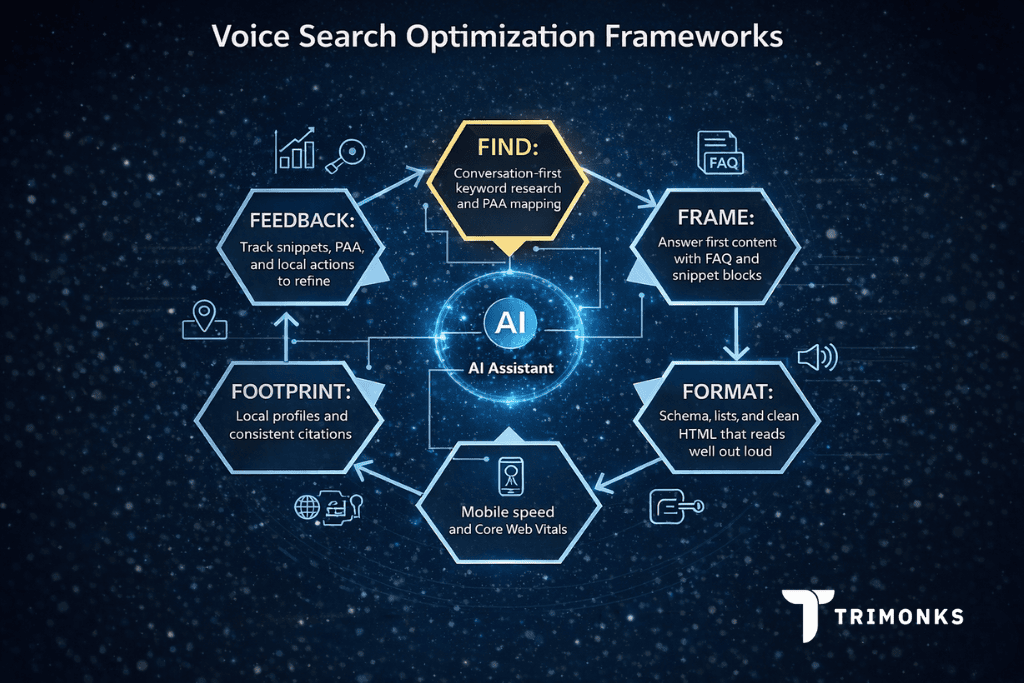
Voice Search Optimization Framework
Find: Conversation-first keyword research and PAA mapping.
Frame: Answer-first content with FAQ and snippet blocks.
Format: Schema, lists, and clean HTML that reads well out loud.
Fast: Mobile speed and Core Web Vitals.
Footprint: Local profiles and consistent citations.
Feedback: Track snippets, PAA, and local actions to refine.
Apply the 80/20 Rule to Prioritize VSO Impact
- Identify the 20 percent of queries that drive 80 percent of high-intent actions. Calls, directions, cart adds.
- Start with pages that can realistically win a snippet within one quarter. Short answers, strong authority, clear structure.
- Focus on local profiles for the top five revenue cities before expanding nationwide.
Measuring Success and Analytics for Voice Search
Track Featured Snippets, PAA, and Entity Visibility
- Monitor featured snippet ownership and PAA placements for target questions. Many voice answers originate here.
- Check Knowledge Panel accuracy for brand and location entities. Consistent facts improve selection odds.
Monitor Local Pack Actions, Calls, and Directions
- Use Google Business Profile insights to track calls, website taps, and direction requests. Voice often routes through these actions.
- Correlate FAQ updates with changes in call volume to validate content impact.
Attribute Conversions from AI assistants and Voice Queries
- Segment question keywords in Search Console. Watch impressions and CTR for “how,” “where,” and “near me.”
- Tag “call now” and “get directions” events. Tie to city pages and language variants to see what actually moves people.
Where Voice Search Optimization is Most Helpful
Local Services, Restaurants, and Hyperlocal Discovery
Voice search optimization is most helpful in time-sensitive, nearby needs. Salons, clinics, gyms, and eateries benefit because the assistant can answer in one line and trigger a call or route. Clean hours, pricing, and booking links usually decide the winner.
E-commerce Product Discovery and Comparison
Short comparisons thrive. “Which mixer grinder under ₹5000 is best for dosa batter?” Answer summaries plus Product and Review schema help a page be chosen and then clicked for details.
BFSI, Healthcare, and Travel Use Cases in India
People ask sensitive and complex questions here. Simple, trustworthy answers build confidence. Think, “What is cashless health insurance?” or “How to reschedule a Vande Bharat ticket?” Clear FAQs and localized language help far more than jargon.
Conclusion and Next Steps
The takeaway is simple. Assistants reward pages that speak like people, answer fast, and prove who they are. Voice search optimization strengthens that trifecta. Start where intent is highest and friction is lowest. Then scale what wins.
90-day Action Plan to Operationalize VSO
- Weeks 1–2: Build a list of 50 conversational and local questions. Map to current pages. Outcome: Clear targets.
- Weeks 3–6: Add answer-first intros, FAQ sections, and schema to 20 priority pages. Outcome: Snippet-ready content.
- Weeks 7–10: Optimize Google Business Profile, fix citations, and create five city pages. Outcome: Local coverage.
- Weeks 11–12: Improve mobile speed on those pages and review insights. Outcome: Faster answers and more calls.
Repeat the loop each quarter. The track featured snippets, PAA, and local actions. Adjust language by city and by language. The brands that keep showing up in spoken answers will keep getting chosen. That is the quiet power of voice search optimization. If you want your brand to be selected as the spoken answer in Google Assistant and AI Overviews, our SEO team at Trimonks can help you implement a complete voice search optimization strategy tailored for your industry and location.